


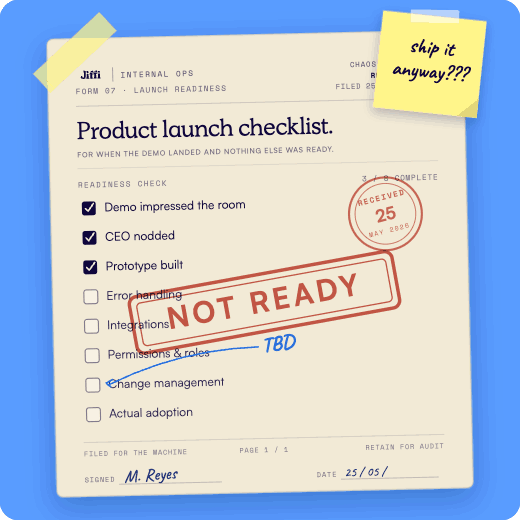


There's a pattern we see constantly. A business gets excited about AI. Someone builds a prototype, and it genuinely impresses the room. The CEO nods, the operations lead says "this could save us hours," and there's talk about rolling it out.
Six months later, it's sitting on someone's laptop, largely untouched.
The prototype wasn't the problem. The gap between a prototype and an actual product is, and it's a gap that almost nobody talks about honestly.
The demo only works when everything goes right
A prototype is built to show what's possible under ideal conditions. Real products have to work when things go sideways to be adopted.
What happens when a user skips a step? When they enter data in an unexpected format? When the system they're connected to is down? What happens when the internet goes down?
Error handling is unglamorous work. It's also the difference between a tool people trust and a tool people abandon the first time it does something weird and gives them no idea why. Most prototypes have none of it. Most products can't function without it.
Your business already has software. The new thing has to talk to it.
One of the most common reasons AI tools stall at the prototype stage is integration. Businesses don't run on blank slates. They've got a CRM, a payroll system, an inventory tool, a booking platform, sometimes all four, sometimes more. Whatever gets built has to exchange and update data with those systems, reliably, in both directions.
Prototypes often skip this entirely. They use dummy data, or a spreadsheet export, or a one-way pull that works fine until the source system updates and nothing syncs. Getting integration right requires understanding the existing ecosystem, not just the new thing.
Technology doesn't implement itself
This one catches people off guard. The assumption is that if the tool is good enough, people will use it. That's rarely how it works.
Change management, getting people to actually adopt new technology, is a human problem, not a software problem. Users need to understand what the tool does and why it's better than what they were doing before. It needs to fit into their actual day, not require them to build a new habit from scratch with no support. The people closest to the problem need to be involved early, not handed something finished and told to get on with it.
Without that, even genuinely useful tools sit unused. Not because they're bad. Because nobody embedded them into the workflow.
The wrong people seeing the wrong things creates the wrong outcomes
Permissions aren't just a security consideration, they're a usability one.
If a team member can't see the information they need to do their job, the tool fails them. If they can see information they shouldn't, you've got a different kind of problem. Getting access levels right by role, by team, by context takes real thought about how the business actually operates. It's not something you configure once and forget.
Prototypes usually treat everyone as the same user. Products can't.
A product nobody uses isn't a product
All of the above feeds into the hardest problem: adoption.
A tool that isn't actively used every day doesn't just fail to deliver value, it erodes trust in the next attempt. Teams that get burned by something that launched with fanfare and then quietly disappeared become harder to bring along the next time.
Real adoption means the tool is genuinely embedded in daily operations. That people reach for it automatically. That it becomes the default, not the experiment.
That doesn't happen by accident. It happens because someone planned for it, not just the build, but the rollout, the training, the feedback loops, the ongoing maintenance.
The build is the easy part
This is hard to say when the build feels so satisfying. But the prototype is the beginning, not the destination.
Getting from a working demo to something your business can actually rely on requires thinking through error handling, integrations, people, permissions, and adoption before you ship, not after. The businesses that get this right treat it as a product problem, not a technology problem.
If you've got something built that's stalled at the prototype stage, or you're about to start something and want to avoid the usual pitfalls, that's exactly the kind of work we do. Try Jiffi AI or book a clarity call with the team.






.avif)