Summary
Are missed calls and backlogged invoicing draining your allied health team? See how to fix the root cause, not just add headcount.
The hidden cost of manual admin in allied health businesses


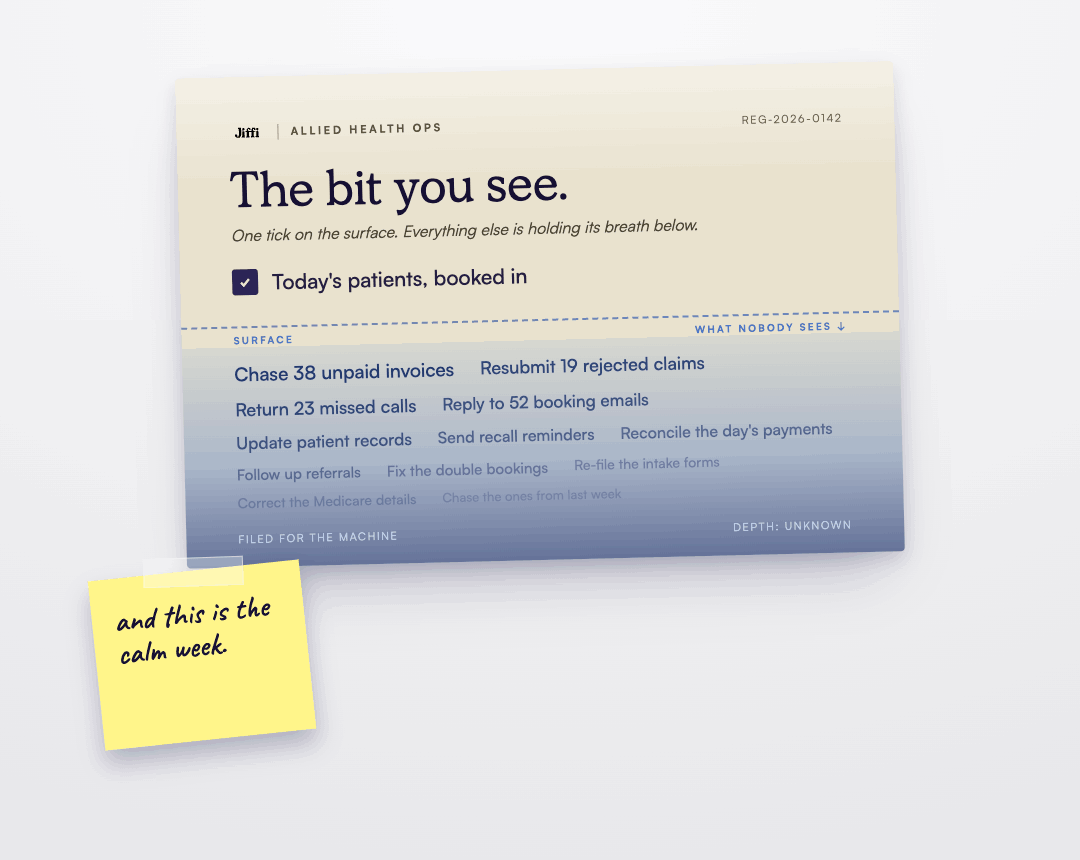
There's a number most allied health business owners have never calculated, not because it's hard to find, but because nobody's ever asked them to look.
It's the cost of manual admin. Not the staff salaries, not the software subscriptions, the actual cost of the hours your team spends doing work that shouldn't need a human. Triaging emails, chasing invoices, logging referrals into a spreadsheet, passing a phone around the office because there's no proper call system.
The problem compounds slowly, and by the time it becomes impossible to ignore, it's already been costing the business for years.
The problem: growth exposes the gaps underneath
When allied health businesses grow, the clinical side scales. Patient volume goes up, referrals come in, and the team expands.
But the infrastructure underneath often doesn't keep pace. The systems that worked when you had twenty patients a week start to buckle at eighty, the shared inbox that was manageable with one admin person becomes chaotic with three, the manual invoicing process that took an hour a day now takes four.
The clinical team fills the gap. They answer phones between appointments, they check the shared inbox on their lunch break, they flag invoicing errors at the end of the day. The work gets done, but at a cost that never shows up anywhere on paper. Until something breaks.
This shows up in three places again and again:
- Calls get missed because there's no real system behind them, just a phone being handed from person to person.
- Communication slips through the cracks because a shared inbox has no ownership and no visibility into what's been actioned.
- Invoicing falls behind because it depends on someone manually re-entering detail that already exists somewhere else in the system.
The solution: fix the foundation, not the headcount
The instinctive response is to hire another coordinator or admin person to own the inbox. It makes sense in the moment. But the new headcount doesn't fix broken systems, it adds capacity to a workflow that was already inefficient. Six months later the new hire is just as overwhelmed as everyone else, and the underlying problem is exactly where it was, just with a higher salary bill.
The fix that actually works addresses each piece at the root:
- A proper call system (not a shared phone) that gives visibility, routing and accountability, so calls stop getting missed.
- A ticketed email system that replaces the shared inbox, so every inquiry has an owner and nothing falls through.
- AI triage on incoming emails and referrals, so the highest-priority communications surface immediately instead of sitting in a queue.
- End-to-end invoicing automation, so what used to take minutes per invoice takes seconds, and backlogs don't build up in the first place.
- The businesses that break the cycle aren't the ones that hire faster. They're the ones that fix the foundation first.
How this played out: Fleet Healthcare
Fleet Healthcare is a Sydney-based mobile healthcare provider delivering allied health services to NDIS, aged care, DVA and private clients in their homes and chosen locations. As patient volume grew, their operational workflows started to crack under exactly this kind of pressure.
Phone calls were managed through a single phone passed around the office. When it wasn't free, calls got missed, and missed calls meant missed referrals.
All patient and referrer communication ran through one shared Gmail inbox, with no way to track ownership or see what had been responded to. Things slipped through, not because the team wasn't working hard, but because a shared inbox was never built to handle that volume or complexity.
Invoicing was heavily manual. Each invoice required significant detail to be added after syncing from their practice management system, and the admin team fell more than two weeks behind, which is as much a cash flow problem as an operational one.
Jiffi addressed each problem at the root rather than adding people to manage the symptoms. We replaced the shared phone with Dialpad, we introduced a ticketed email system in place of the shared Gmail inbox. We added AI triage so high-priority referrals and appointment requests got faster responses, and we automated invoicing end to end, clearing the two-week backlog and bringing it fully current.
The result: 60% of simple patient queries now resolved automatically. No new headcount required.
The question worth asking
If someone tracked every minute of admin time in your allied health business for 30 days, what would the number come back at?
Most operators have a rough sense that it's too high, very few have ever put a real figure on it. And without a number, it's almost impossible to make the case for fixing it, to yourself, to your leadership team, or to anyone else.
The fix is rarely as complicated as it feels from the inside, it usually starts with seeing the problem clearly.
If your allied health business is missing calls, falling behind on invoicing, or about to hire just to keep up, book a free 30-minute clarity call. We'll go through your operation and tell you exactly where the time is going and what fixing it would actually look like.
Latest articles


 Published May 4, 2026
The AI-to-ops gap: why most businesses are stuck, and what actually fixes it